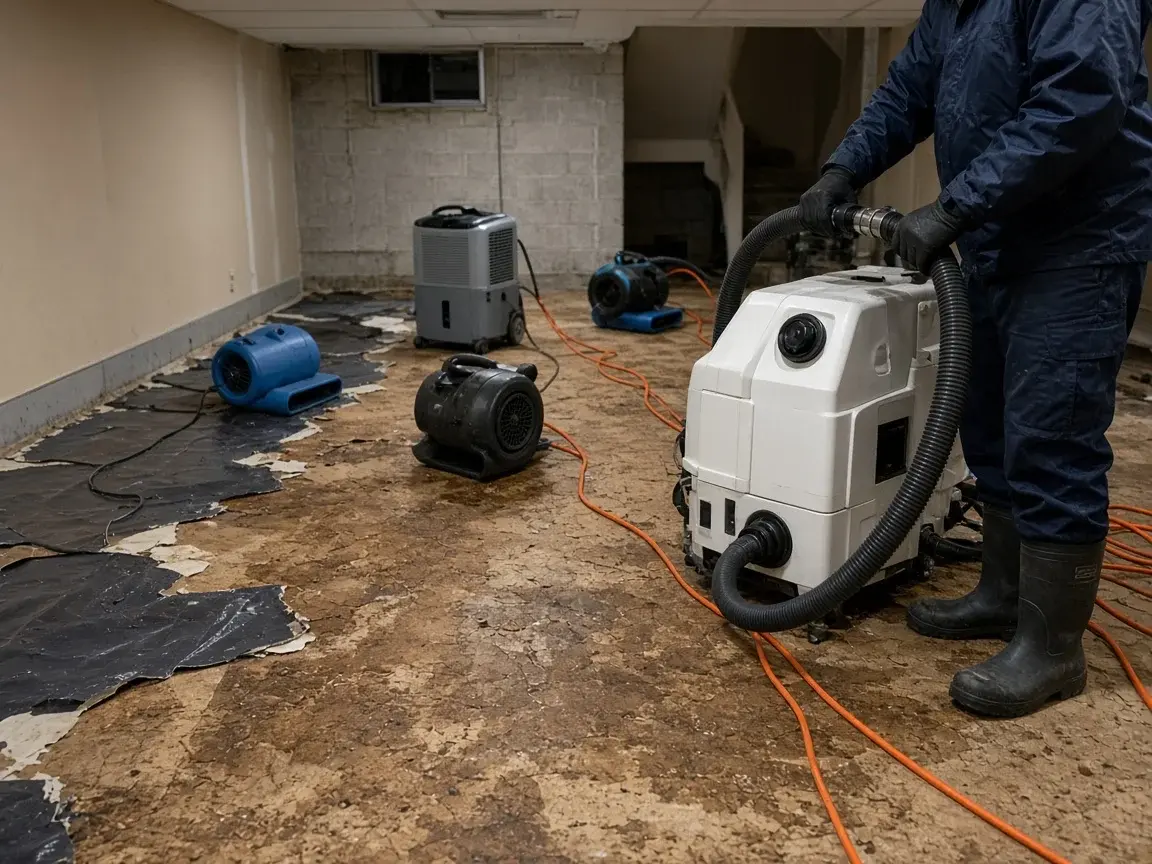
Water Damage Restoration in Abbotsford, BC
Category 1, 2, and 3 water damage extraction and structural drying. LGR dehumidifiers, air movers, and moisture mapping for Abbotsford properties.
Water damage restoration in Abbotsford involves two critical time windows that determine how much damage you ultimately face. The first is the 24-48 hour window after a water event, during which mold has not yet established and structural drying can prevent mold growth entirely. The second is the 72-hour-plus window, after which mold has very likely begun colonising wet porous materials and extraction alone is no longer sufficient — material removal and remediation will be required in addition to drying.
The IICRC S500 Standard for Professional Water Damage Restoration classifies water damage into three categories based on water source contamination level. Category 1 (clean water from supply lines, overflowing sinks) has the widest window for in-place drying. Category 2 (grey water from dishwashers, washing machines, toilet overflow without feces) requires faster response and more aggressive material removal. Category 3 (black water from sewage backup, rising groundwater, river flooding) requires immediate removal of all affected porous materials regardless of elapsed time.
Abbotsford's geographic position in the Fraser Valley means water damage restoration is a significant need throughout the region. The combination of aging municipal stormwater infrastructure, flat topography with limited natural drainage, high water table in many areas, and extreme rainfall events in the fall and winter creates persistent water intrusion risks for basements, crawlspaces, and ground-floor slabs across the city.
What's Included with Water Damage Restoration
- ✓Emergency water extraction using truck-mounted or portable extraction equipment
- ✓IICRC S500 water damage category assessment (Category 1, 2, or 3)
- ✓Pre-drying moisture baseline: wood moisture content, concrete slab reading, and ambient RH
- ✓Selective demolition of non-salvageable materials (Category 2/3 porous materials in contact with contaminated water)
- ✓Strategic placement of LGR (Low-Grain Refrigerant) dehumidifiers and high-velocity air movers
- ✓Daily monitoring with Tramex moisture meters and psychrometric data logging
- ✓IICRC S520 mold assessment if water has been standing for 72+ hours
- ✓Antimicrobial application to all cleaned surfaces post-extraction
- ✓Structural drying to IICRC S500 drying goals (wood below 16%, concrete below 1% MC)
- ✓Written drying log with daily readings documenting the drying curve and completion
When Abbotsford Homeowners Need Water Damage Restoration
Burst supply line or appliance failure
A burst dishwasher hose, failed washing machine supply line, or ruptured copper supply line can discharge hundreds of litres of clean water (Category 1) into a kitchen, bathroom, or laundry area before it's detected. Rapid extraction and immediate deployment of drying equipment can preserve most or all of the affected materials if initiated within the first 24 hours.
Sewer backup or toilet overflow
Sewer backup events are Category 3 — the most serious water damage classification. All porous materials (carpet, pad, drywall, insulation) that have been in contact with sewage must be removed immediately, regardless of elapsed time. The area must be disinfected with appropriate EPA-registered antimicrobials before reconstruction.
Flooding from heavy rainfall
Abbotsford's flat terrain and aging drainage infrastructure mean that heavy rainfall events can cause widespread basement flooding, particularly in older neighbourhoods. Floodwater that has contacted soil and municipal drainage is typically Category 3. Prompt extraction is critical to prevent structural damage and mold establishment.
Our Water Damage Restoration Process
Emergency extraction
Portable submersible pumps are used for standing water. Truck-mounted or portable extraction wands remove water from carpet, pad, and hard floor surfaces. The goal in the extraction phase is to remove as much free water as possible before deploying drying equipment — wet vacuuming alone will not dry a water-damaged structure.
Selective demolition
Based on the water category and elapsed time, we determine what materials need to come out. Category 2 and 3 materials (carpet, pad, drywall, insulation) in contact with contaminated water are always removed. Category 1 materials that have been wet for more than 72 hours are assessed on an individual basis.
Drying equipment deployment
Dri-Eaz LGR Defender or equivalent commercial low-grain refrigerant dehumidifiers are placed at the rate of one per 30–40 m² of affected floor area. Dri-Eaz Velo or equivalent high-velocity air movers are strategically placed to create an airflow pattern that moves moisture from wet structural materials into the dehumidified airstream.
Daily monitoring and adjustment
Moisture readings are taken daily at all documented monitoring points. Psychrometric data (temperature, RH, GPP — grains per pound) is logged to document the drying curve. Equipment placement is adjusted as drying progresses. Drying is complete when all readings reach IICRC S500 drying goals for the specific material and temperature class.
Why Choose Abbotsford Mold Removal Co. for Water Damage Restoration?
IICRC Certified
Every technician follows IICRC S520 and S500 standards. That's the industry framework — not a marketing claim.
Third-Party Clearance
We don't certify our own work. Post-treatment verification goes to an independent accredited laboratory.
Full Documentation
You receive a written record of all work: moisture readings, material removal, treatment, and clearance results.
Water Damage Restoration — Areas We Serve
We provide water damage restoration services in Abbotsford and throughout the Fraser Valley, including Langley, Chilliwack, Mission, Maple Ridge, Hope, Aldergrove, Sardis, and Agassiz.
View all service areas →Water Damage Restoration — Common Questions
Need Water Damage Restoration in Abbotsford?
Call Abbotsford Mold Removal Co. now. We'll assess the situation and tell you exactly what needs to be done — available 24/7 for emergency situations.