Crawlspace Mold Removal in Abbotsford, BC
Subfloor joist and crawlspace mold removal with vapour barrier installation and sealed vent assessment. Built for BC's wet climate.
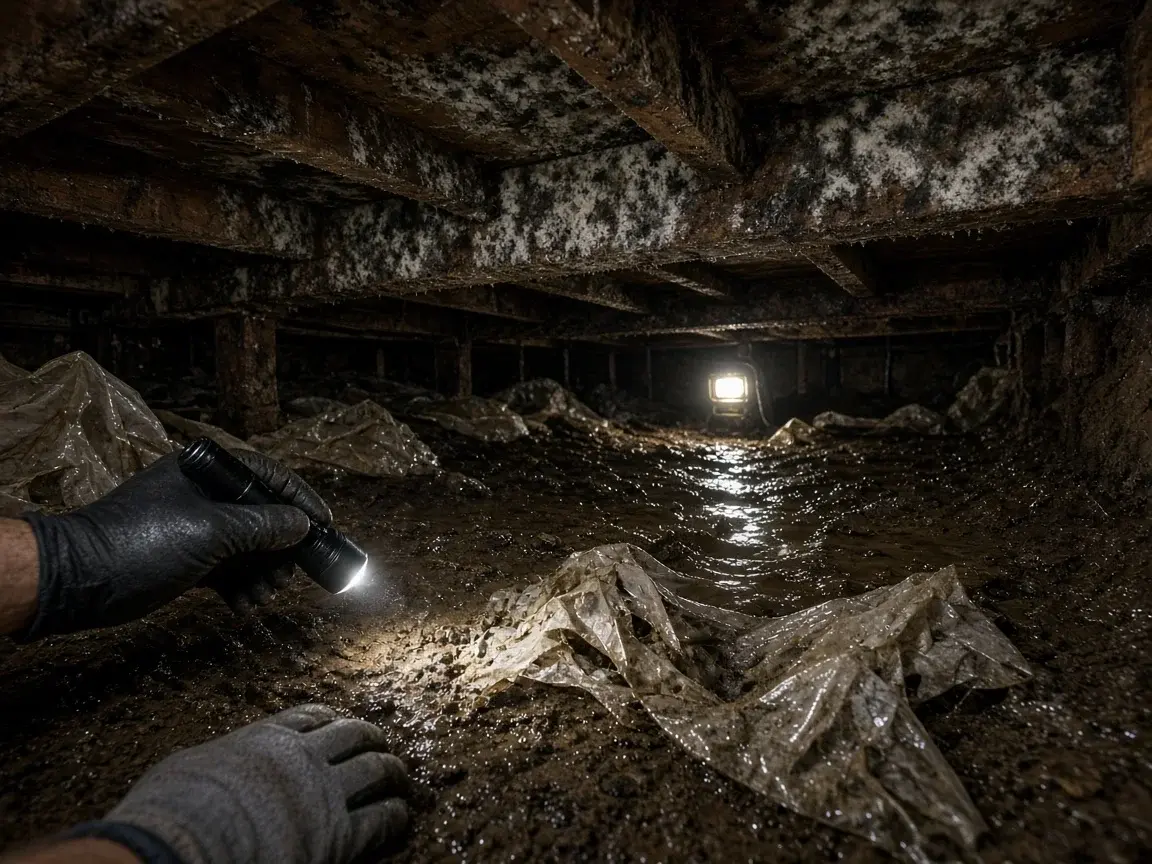
Crawlspace mold is one of the most structurally significant mold problems in Abbotsford homes, and one of the most underappreciated. The crawlspace sits directly below the living areas of the home, and mold-contaminated air from a wet, poorly ventilated crawlspace migrates upward through the stack effect — the natural convection of warm air rising through a building. That means crawlspace mold contributes directly to the air quality of the rooms above it.
Abbotsford's water table and soil moisture conditions make crawlspace moisture management especially challenging. Properties in lower-lying areas near the Vedder River floodplain, in Matsqui Prairie, and in parts of West Abbotsford near the US border sit on soils that retain moisture year-round. Without a properly installed and maintained vapour barrier, ground moisture evaporates into the crawlspace continuously, raising relative humidity to levels that consistently exceed 70% — well above the 60% threshold where mold growth accelerates on wood substrates.
The structural wood components of a crawlspace — floor joists, rim joists, beam pockets, and subfloor decking — are all organic materials that support fungal growth when moisture is present. Mold on structural wood in a crawlspace isn't just a cosmetic problem. Extensive fungal growth causes progressive degradation of wood fibre — what's sometimes called wood rot or wet rot — that reduces the structural capacity of floor joists over time. Early intervention prevents structural consequences.
What's Included with Crawlspace Mold Removal
- ✓Full crawlspace moisture assessment including soil moisture, RH readings, and wood moisture content throughout
- ✓Vapour barrier condition assessment (existing barrier inspection or absent barrier documentation)
- ✓Floor joist, rim joist, and subfloor inspection for mold coverage and structural integrity
- ✓HEPA removal of all mold growth from wood joists, rim joists, and subfloor
- ✓Wire brushing of all mold-colonised wood surfaces
- ✓Application of penetrating antimicrobial and encapsulant to all treated wood surfaces
- ✓Ventilation assessment (passive vent calculation, inspection of vent screens and blockages)
- ✓Crawlspace dehumidifier assessment and recommendations for ongoing moisture control
- ✓New 6-mil or reinforced poly vapour barrier installation over soil (where old barrier is failed or absent)
- ✓Post-treatment air sampling from crawlspace and above the crawlspace floor in living areas
When Abbotsford Homeowners Need Crawlspace Mold Removal
Failed or absent vapour barrier
The single most common crawlspace mold cause in Abbotsford is a missing, torn, or inadequately overlapped vapour barrier. Without a physical barrier between the soil and the crawlspace air, ground moisture evaporates freely into the space. Wood moisture content in the floor joists above can exceed 25–30% (structural damage threshold) within one to two BC wet seasons.
Blocked passive vents
Older crawlspaces rely on passive perimeter vents to move moisture-laden air out. In many Abbotsford homes these vents are blocked by landscaping, stored materials against the foundation, or closed by homeowners who (incorrectly) believe they should be closed in winter. Blocked vents allow humidity to accumulate, and in a BC winter the combination of high soil moisture and blocked ventilation means a crawlspace can maintain 85–95% RH for months.
Standing water from plumbing or groundwater
Plumbing leaks from supply lines or drain pipes in the crawlspace, or groundwater infiltration through the foundation, can create standing water conditions. Mold growth on structural wood above standing water is extremely aggressive — within weeks of sustained contact, Stachybotrys and wood-decay fungi can establish on joist undersides. This requires urgent intervention.
Our Crawlspace Mold Removal Process
Entry assessment and documentation
We enter the crawlspace and take a systematic grid of wood moisture content readings using a Protimeter Surveymaster in pin mode, mapping all areas with readings above 18%. Relative humidity is measured at multiple points. Photographs document the condition of the vapour barrier, venting, insulation, and structural wood.
Mold identification and contamination mapping
We visually map the extent of mold growth on all wood surfaces — joists, rim joists, ledger boards, beams, subfloor decking. Mold coverage is categorised as light surface (less than 10% coverage), moderate (10–50%), or heavy (greater than 50%). Heavy coverage often indicates wood-decay fungi in addition to surface mold, which has structural implications.
Wire brushing and HEPA vacuuming
All mold-colonised wood surfaces are aggressively wire-brushed to remove surface mold hyphae and to open the wood surface for antimicrobial penetration. HEPA vacuuming removes all dislodged material before it can become airborne in the crawlspace air. Both are done while workers wear half-face respirators with P100 cartridges minimum.
Antimicrobial and encapsulant application
Treated wood surfaces receive a penetrating antimicrobial treatment followed by an encapsulant coating where indicated. Encapsulation creates a physical barrier over any remaining embedded mold residue and provides an ongoing antimicrobial surface. All treated surfaces in the crawlspace — wood, soil (if exposed), concrete block foundation — receive treatment.
Vapour barrier and ventilation
A new 6-mil minimum polyethylene vapour barrier is installed over the soil where the existing barrier is failed or absent. Seams are overlapped a minimum of 12 inches and taped. The barrier runs up the foundation walls and is fastened. Passive vents are inspected and cleared; a crawlspace dehumidifier is recommended for properties where the passive venting is insufficient to maintain RH below 60%.
Why Choose Abbotsford Mold Removal Co. for Crawlspace Mold Removal?
IICRC Certified
Every technician follows IICRC S520 and S500 standards. That's the industry framework — not a marketing claim.
Third-Party Clearance
We don't certify our own work. Post-treatment verification goes to an independent accredited laboratory.
Full Documentation
You receive a written record of all work: moisture readings, material removal, treatment, and clearance results.
Crawlspace Mold Removal — Areas We Serve
We provide crawlspace mold removal services in Abbotsford and throughout the Fraser Valley, including Langley, Chilliwack, Mission, Maple Ridge, Hope, Aldergrove, Sardis, and Agassiz.
View all service areas →Crawlspace Mold Removal — Common Questions
Need Crawlspace Mold Removal in Abbotsford?
Call Abbotsford Mold Removal Co. now. We'll assess the situation and tell you exactly what needs to be done — available 24/7 for emergency situations.