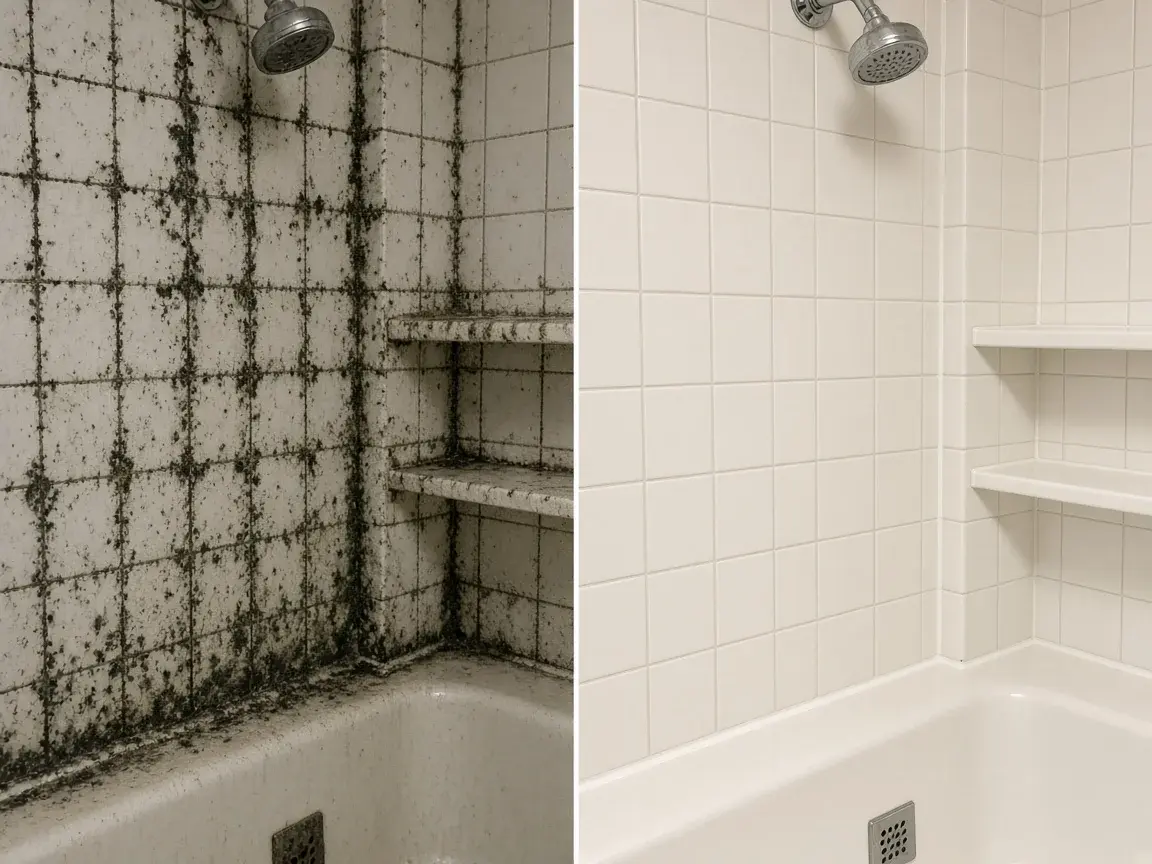
Bathroom Mold Removal in Abbotsford, BC
Grout, caulk, tile, and drywall mold in bathrooms. Proper extraction without damaging fixtures, plus ventilation assessment to prevent return.
Bathroom mold is the most common type of mold problem in Abbotsford homes, and it's almost always a ventilation failure. Bathrooms produce enormous quantities of moisture — a hot shower deposits 10–15 grams of water per cubic metre of air — and that moisture needs somewhere to go. When a bathroom exhaust fan is inadequate, blocked, or (extremely common in BC) vented into the attic instead of outside, that moisture stays in the room and feeds mold growth in grout, caulk, drywall, and wall cavities.
Bathroom mold in Abbotsford also gets worse in the fall and winter when outdoor temperatures drop. Cold exterior walls create condensation zones where warm, humid bathroom air meets a cold surface — typically around windows, on exterior wall drywall behind tile, and on the lower sections of exterior-facing shower walls. This condensation is invisible from the front face of the tile but can be producing mold growth on the back side for months or years.
The wrong approach to bathroom mold is cleaning with bleach and grout re-sealing. This addresses the surface symptom but not the underlying moisture problem. If the ventilation isn't fixed, the mold is back within three to six months — often worse, because bleach-resistant species tend to colonise after repeated bleach treatments.
What's Included with Bathroom Mold Removal
- ✓Exhaust fan assessment including airflow measurement with an anemometer (minimum 50 CFM for standard bathroom)
- ✓Thermal imaging of bathroom walls to detect condensation zones and moisture behind tile
- ✓Grout and caulk inspection for mold depth and substrate penetration
- ✓Tile removal where mold has penetrated behind the tile substrate
- ✓Drywall inspection and removal where moisture readings indicate saturation
- ✓HEPA removal of all mold-contaminated materials from grout, caulk, and tile backs
- ✓Antimicrobial treatment of all cleaned substrate surfaces
- ✓Installation of mold-resistant cement board where drywall is removed in wet areas
- ✓New grout sealing with penetrating silicone grout sealer
- ✓Ventilation assessment and improvement recommendations
When Abbotsford Homeowners Need Bathroom Mold Removal
Black mold on shower grout and caulk
Dark mold colonising grout joints and caulk seams is the most visible bathroom mold presentation. In mild cases it's surface Cladosporium or Penicillium. In more advanced cases, particularly around the caulk at the tub-to-wall joint, Stachybotrys can establish when the caulk has failed and water is repeatedly getting behind the fixture. Caulk replacement alone doesn't solve this — the area behind needs to be dried and treated.
Mold behind drywall in the shower
Pre-2000 homes in Abbotsford often have regular paper-faced drywall behind tile in wet areas instead of cement board or fibre-cement backer board. When tile grout or caulk fails and water gets through, that drywall becomes heavily mold-contaminated. This requires tile removal, drywall demolition, mold treatment, and reconstruction with proper wet-area substrate.
Musty bathroom smell without visible mold
If your bathroom smells musty but you can't see mold, it's often growing behind the bathroom fan housing, in the ceiling drywall around the fan, or on the back side of the vanity cabinet. Bathroom fan assemblies are mold reservoirs when they don't pull enough air — the motor housing becomes a damp, warm, still space perfect for growth.
Our Bathroom Mold Removal Process
Ventilation and moisture assessment
We measure actual airflow from the exhaust fan using an anemometer and compare to the room's required CFM based on square footage. A standard Abbotsford bathroom needs minimum 50 CFM of active exhaust — many older homes have fans that are physically blocked by insulation in the duct, have kinked flexible duct runs, or vent into the attic. We identify and document the failure mode.
Thermal imaging scan
A thermal imaging camera reveals condensation zones invisible to the naked eye — cold spots on exterior walls behind tile, wet areas around window frames, and moisture tracking down wall cavities. This tells us where mold is likely growing behind the finish surface before we open anything.
Surface treatment (minor cases)
For mold limited to non-porous tile surfaces, we use HEPA vacuuming followed by application of a quaternary ammonium or hydrogen peroxide-based antimicrobial. Grout is treated with a penetrating antimicrobial cleaner, re-raked where needed, and sealed. Caulk is fully removed, the joint is dried and treated, and new 100% silicone caulk is applied.
Tile and drywall removal (advanced cases)
Where moisture readings indicate water penetration behind tile, or where thermal imaging shows an active condensation zone, the affected tile is removed and the substrate inspected. Mold-contaminated drywall is removed and replaced with cement board backer after treating the framing and any mold on adjacent structural elements.
Why Choose Abbotsford Mold Removal Co. for Bathroom Mold Removal?
IICRC Certified
Every technician follows IICRC S520 and S500 standards. That's the industry framework — not a marketing claim.
Third-Party Clearance
We don't certify our own work. Post-treatment verification goes to an independent accredited laboratory.
Full Documentation
You receive a written record of all work: moisture readings, material removal, treatment, and clearance results.
Bathroom Mold Removal — Areas We Serve
We provide bathroom mold removal services in Abbotsford and throughout the Fraser Valley, including Langley, Chilliwack, Mission, Maple Ridge, Hope, Aldergrove, Sardis, and Agassiz.
View all service areas →Bathroom Mold Removal — Common Questions
Need Bathroom Mold Removal in Abbotsford?
Call Abbotsford Mold Removal Co. now. We'll assess the situation and tell you exactly what needs to be done — available 24/7 for emergency situations.