Kitchen Mold Removal in Abbotsford, BC
Under-sink, behind appliances, cabinet interiors, and subfloor mold in kitchens. Safe removal around food prep surfaces with full decontamination.
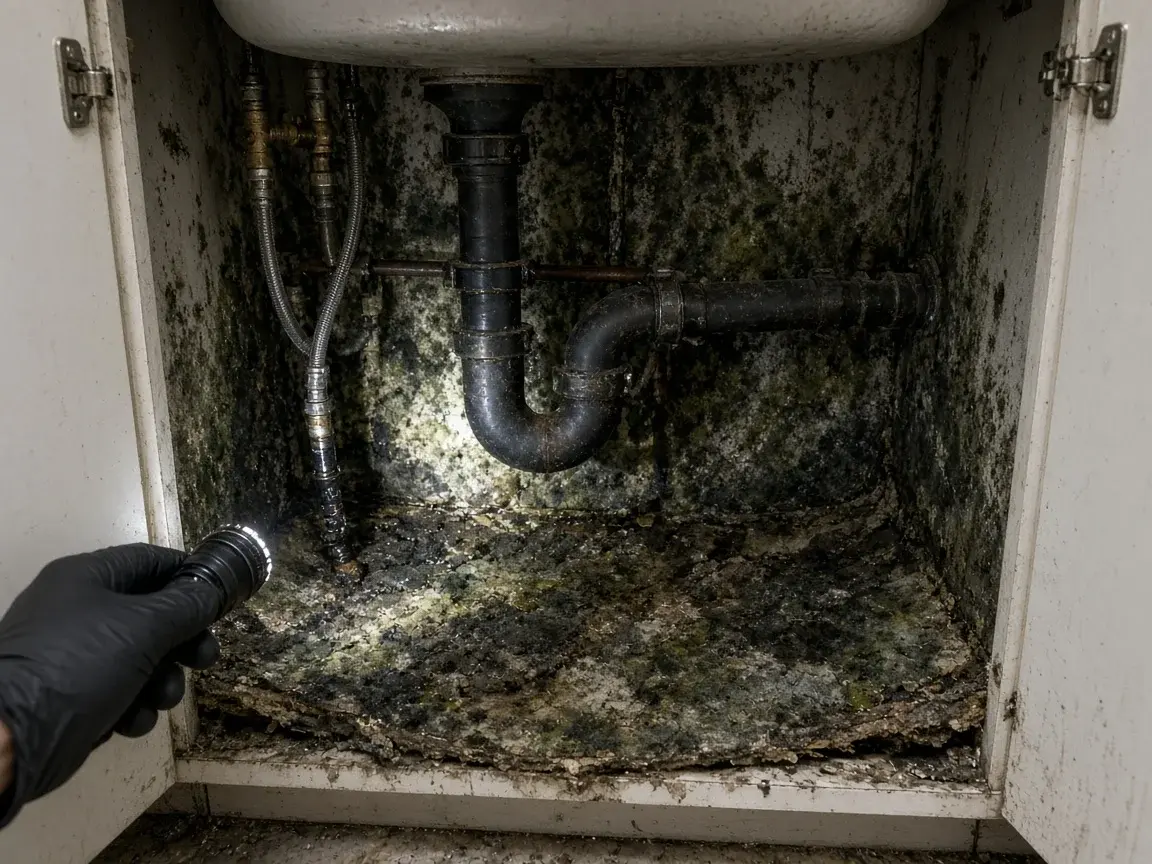
Kitchen mold in Abbotsford homes most commonly develops in three zones: under the sink, behind the dishwasher, and inside lower kitchen cabinets on exterior walls. Each has a different moisture source, and each requires a specific approach. Under-sink mold is almost always from a plumbing leak — supply line, drain basket, P-trap, or garbage disposal connection. Behind-dishwasher mold typically comes from a failed door gasket or a kinked drain line. Exterior wall cabinet mold comes from the same condensation mechanism as bathroom mold: warm kitchen air hitting a cold exterior wall surface.
What makes kitchen mold particularly problematic is the substrate. Cabinet base plates are almost universally particle board — a compressed wood product with paper facing that is essentially a perfect mold growth medium. When particle board gets wet, it swells, delaminates, and colonises heavily within 48–72 hours. It does not dry out and recover. Once particle board has been significantly wetted, it needs to come out.
Kitchen mold also carries health implications specific to the space. Mycotoxins from mold growth near food preparation surfaces can deposit on cookware, cutting boards, and food. This is one situation where surface cleaning alone is inadequate — the contaminated substrate must be removed and the area properly decontaminated before food preparation resumes.
What's Included with Kitchen Mold Removal
- ✓Inspection of all under-sink plumbing connections with documentation of leak sources
- ✓Dishwasher drain line and door gasket inspection
- ✓Moisture mapping of all lower cabinet zones, particularly on exterior-facing walls
- ✓Thermal imaging scan of exterior kitchen walls for condensation zones
- ✓Safe removal of mold-contaminated particle board cabinet bases and backs
- ✓HEPA vacuuming and antimicrobial treatment of all cabinet interiors and adjacent structural surfaces
- ✓Sub-floor inspection and treatment where moisture has penetrated below cabinet base
- ✓Documentation of all plumbing deficiencies requiring repair before reconstruction
- ✓Antimicrobial treatment of all interior cabinet surfaces within the affected zone
- ✓Air sampling post-removal (for larger kitchen contamination jobs)
When Abbotsford Homeowners Need Kitchen Mold Removal
Long-term under-sink plumbing leak
A slow drip from a P-trap, drain basket, or supply line under the kitchen sink can go undetected for months. The particle board cabinet base and back wall absorb moisture continuously, and by the time you notice the cabinet door is hard to open (because the particle board has swollen), you have extensive mold growth throughout the cabinet interior and possibly on the subfloor beneath.
Dishwasher drain backup or door seal failure
A failed dishwasher door gasket or a kinked drain line can direct water into the cabinet space on either side of the dishwasher. This is often invisible until the flooring delaminates or a neighbouring cabinet base is found to be wet. The area behind and below the dishwasher is a confined, damp, warm space — ideal mold conditions.
Exterior wall cabinet condensation
In Abbotsford winters, kitchen cabinets mounted on exterior walls can experience significant condensation on the back panel. The cabinet interior stays warm and humid from cooking, the exterior wall surface is cold, and moisture condenses on the back panel repeatedly throughout the winter. Insulation that has been compressed by pipes or wires is particularly prone to allowing a cold surface to develop within the wall assembly.
Our Kitchen Mold Removal Process
Leak identification and documentation
Every under-sink plumbing connection is inspected and tested: supply valves, supply lines, drain basket, P-trap, garbage disposal connections, and any dishwasher supply or drain connections. All active or historical leaks are documented and photographed for your plumber to repair before reconstruction.
Cabinet base and back removal
Mold-contaminated particle board is removed from the cabinet interior — base plate, back panel, and any side panels with elevated moisture readings. This material is double-bagged and removed from the containment zone. The underlying sub-floor and wall framing are inspected and moisture-mapped.
Sub-floor and framing treatment
If moisture has penetrated to the sub-floor below the cabinet, affected OSB or plywood is removed and the floor joists below are inspected and treated. Structural wood framing with surface mold growth is wire-brushed and treated with antimicrobial before any reconstruction.
Post-treatment and closure
All treated surfaces receive an application of EPA-registered antimicrobial. The space is allowed to dry to acceptable moisture content before new cabinet bases or reconstruction begins. For larger jobs, post-treatment air sampling confirms the area is clean before reconstruction.
Why Choose Abbotsford Mold Removal Co. for Kitchen Mold Removal?
IICRC Certified
Every technician follows IICRC S520 and S500 standards. That's the industry framework — not a marketing claim.
Third-Party Clearance
We don't certify our own work. Post-treatment verification goes to an independent accredited laboratory.
Full Documentation
You receive a written record of all work: moisture readings, material removal, treatment, and clearance results.
Kitchen Mold Removal — Areas We Serve
We provide kitchen mold removal services in Abbotsford and throughout the Fraser Valley, including Langley, Chilliwack, Mission, Maple Ridge, Hope, Aldergrove, Sardis, and Agassiz.
View all service areas →Kitchen Mold Removal — Common Questions
Need Kitchen Mold Removal in Abbotsford?
Call Abbotsford Mold Removal Co. now. We'll assess the situation and tell you exactly what needs to be done — available 24/7 for emergency situations.